Blog
Your first osteopath appointment: what to expect
Getting ready for your first osteopathy appointment and wondering how it will go? I’ll explain how a session works at my practice in Rosemont-La Petite-Patrie, what to plan for and what comes after.
By Nicolas Acquié, osteopath D.O.
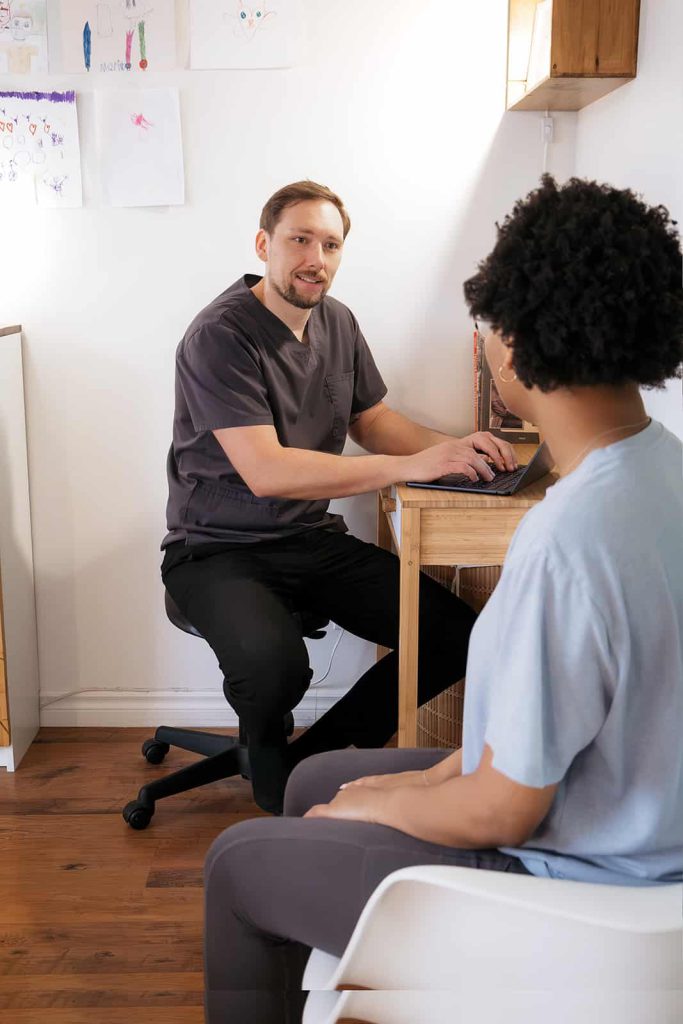
Osteopathy is a real passion, and taking the time to listen, to explain and to look for solutions is part of what I love (among other things) about my work.
Is this your first osteopathy session?
You can see an osteopath directly, without a doctor’s referral. Osteopathy works alongside your medical care, never in place of it. I take a hands-on approach, with a gentle touch, and I adapt each session to the person in front of me.
I see people of all ages, from little ones to seniors.
What happens at a first appointment?
Time to get to know each other
I place great importance on understanding the demands you deal with every day.
To get a holistic (= overall) view of your situation, the osteopathy session is divided into two parts: a “theoretical” part, the case history, and a “practical” part. The case history is an in-depth questionnaire. It lets us go over the complaint (or complaints) behind your appointment.
This step also lets me learn about your past: injuries you’ve been through, surgeries you’ve had, long-standing discomfort. This theoretical part is a special time to “get to know each other”.
Observation
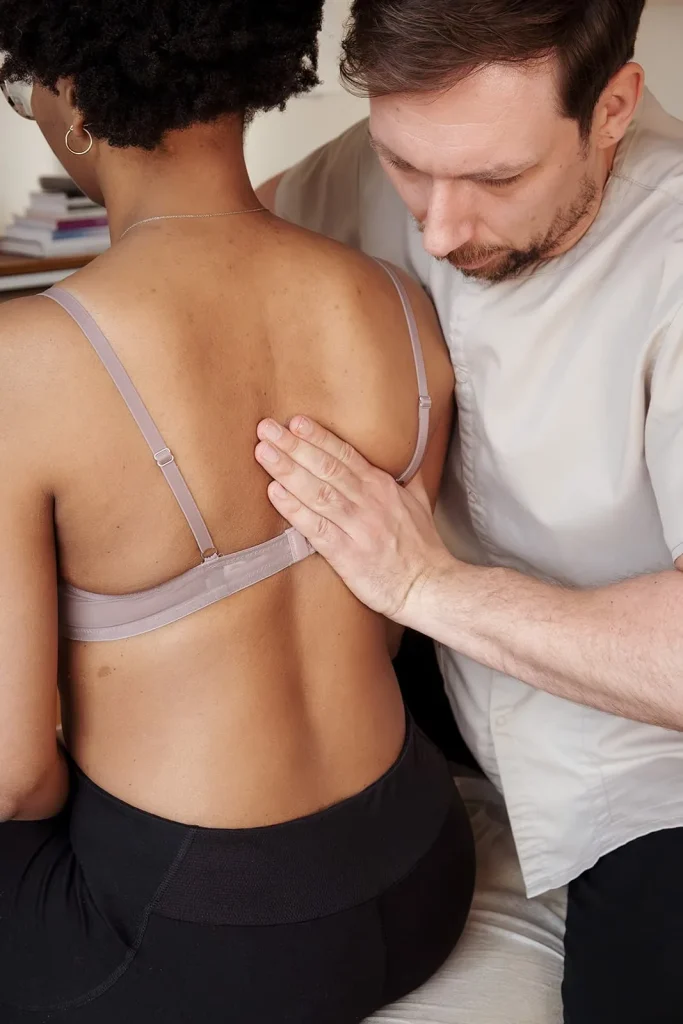
The “practical” part starts with an observation step. It lets me see your “posture” and how your joints move.
As the appointment goes on, I share explanations with you about the areas I’m working on and the techniques I’m using, so that you understand what’s happening during the session.
The treatment
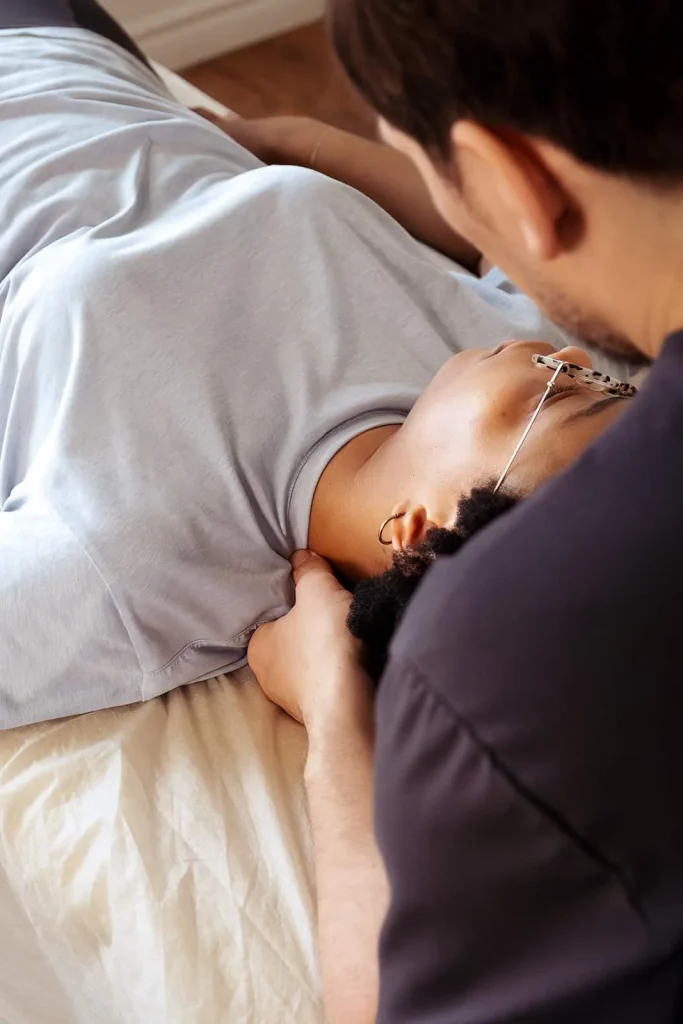
The osteopathic treatment step comes next. During this step, I make mobility adjustments based on my osteopathic tests. I use gentle hands-on techniques, without medication or forceful manipulation, to help your body move more freely and let go of tension.
Advice for what comes next
Some basic advice wraps up the appointment. It helps you get the most out of the osteopathic treatment. I’m not a doctor, a physiotherapist or a psychologist: my advice is an osteopath’s advice.
Is one session enough?
Often, one session is enough to help you, sometimes two, rarely three. That’s what we figure out together at the first appointment. If there’s no improvement after three sessions, I’ll generally point you toward another professional.
What should you wear, and what should you plan for?
- Come in comfortable clothes: shorts or yoga pants will be our best friend (it’s hard to assess a knee’s range of motion in tight jeans). If, on the day of your appointment, you didn’t plan to or forgot to bring loose, comfortable clothes, I’ll lend you a pair of shorts.
- Bring anything that can help me understand your situation: your recent test results or medical reports if you have any, your list of medications and, for a baby, their health record book.
- If someone comes with you, they can wait in the centre’s waiting room, or stay with you during the session if you’d like. For a baby, the parents stay close throughout the session. For a child under 14, I need the consent of a parent or guardian before the session, as required by Ostéopathie Québec’s code of ethics (in French).
- You’ll find me at the Centre professionnel Makisa, 910 rue Bélanger Est, Suite 206, Montréal, Québec H2S 3P4, between Saint-André and Boyer streets. You’ll get directions for entering the waiting room with your appointment confirmation.
Good to know
Osteopathy sessions are not covered by RAMQ, which runs Québec’s public health insurance plan. Many private insurance plans cover part or all of the cost: check your “paramedical services” or “alternative therapies” coverage with your insurer. You receive a receipt by email, which you can submit to your insurer for reimbursement. Interac e-Transfer is the preferred way to pay.
How long does the session last?
A session lasts 1 hour. The first one costs the same as the ones that follow. For this first session, I take the time to understand your story and what you go through day to day.
And after the session?
You may feel a little tired: that’s normal. The effects of the session can also be felt in the days that follow, depending on how your body responds.
I recommend that you keep moving, so your body can carry on the work we did together. If a reaction leaves you wondering, send me a message: I’m available.
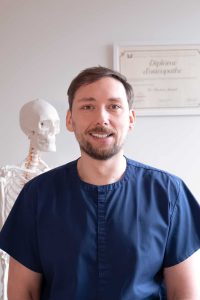
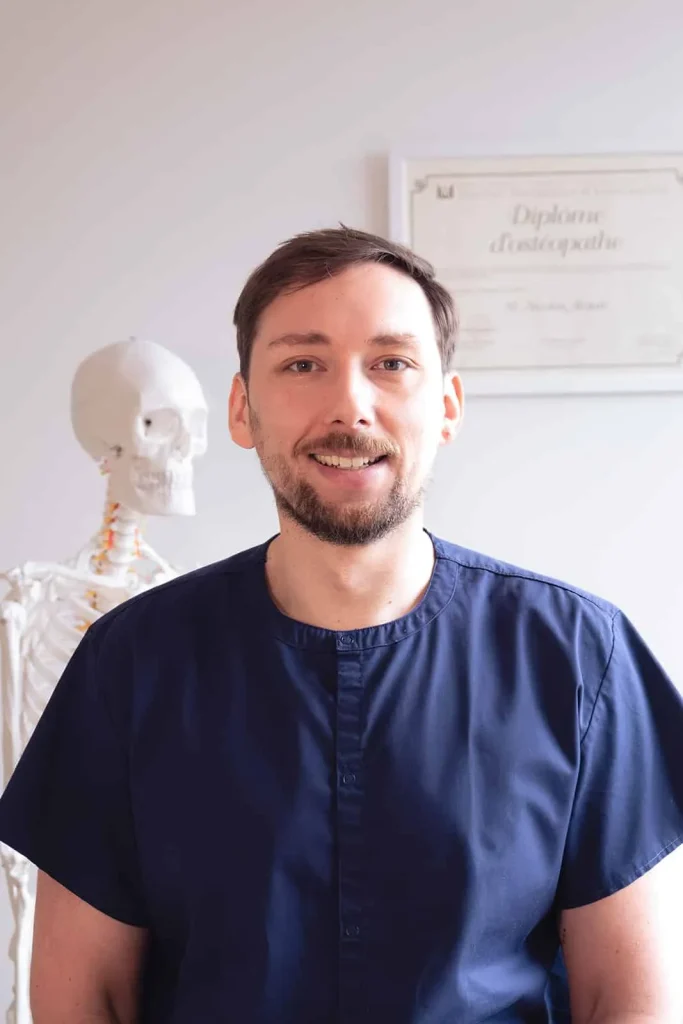
Nicolas Acquié, osteopath D.O.
I’m an osteopath D.O. (graduate in osteopathy). I earned my diploma at the Institut Toulousain d’Ostéopathie (France) in 2013. I also teach at the IEOQ, the Institut d’Enseignement de l’Ostéopathie du Québec. You’ll find me at my practice in Rosemont-La Petite-Patrie.
My backgroundAlso worth reading
Book your first appointment
When the time is right for you, book online on GOrendezvous, or by text at 514-663-3826.
Before you come, and after: your questions
Does osteopathy really work?
Yes, osteopathy is effective, especially when your complaint has a mechanical component. And discomfort is never purely physical. There is a mental and social dimension. That’s why I place great importance on listening, and on explaining what we’re doing together, throughout the session.
Does what I tell you stay confidential?
What you tell me stays confidential. I don’t share it with anyone without your permission, except in the specific cases set out in the law and in Ostéopathie Québec’s code of ethics. Like all osteopaths, I must also comply with Québec’s Law 25, which protects your personal information.
Can I stop the session at any time?
Yes, you can stop the session at any time. It’s up to me to make sure your consent stays free and informed from start to finish. I work with you, always respecting your limits and your needs.
What should you avoid after a session?
It’s important to avoid being too inactive. The goal of osteopathy is to give you back options for movement and to improve the quality of your tissues. So after a session, it’s important to get moving again: walking, moving around…
Is it normal to be more sore after a session?
It’s possible. Some passing discomfort can sometimes be felt in the 24 to 48 hours after a session. If it surprises you, you can send me a message. Of course, I’m available for any kind of question.