Pregnancy and postpartum
Pregnancy osteopath
Are you pregnant and feeling tension, discomfort in your lower back or a more general discomfort? You’ll find me in Montréal, in the La Petite-Patrie neighbourhood, where I offer osteopathy sessions adapted to pregnancy. They complement your medical care. I also support you after childbirth.
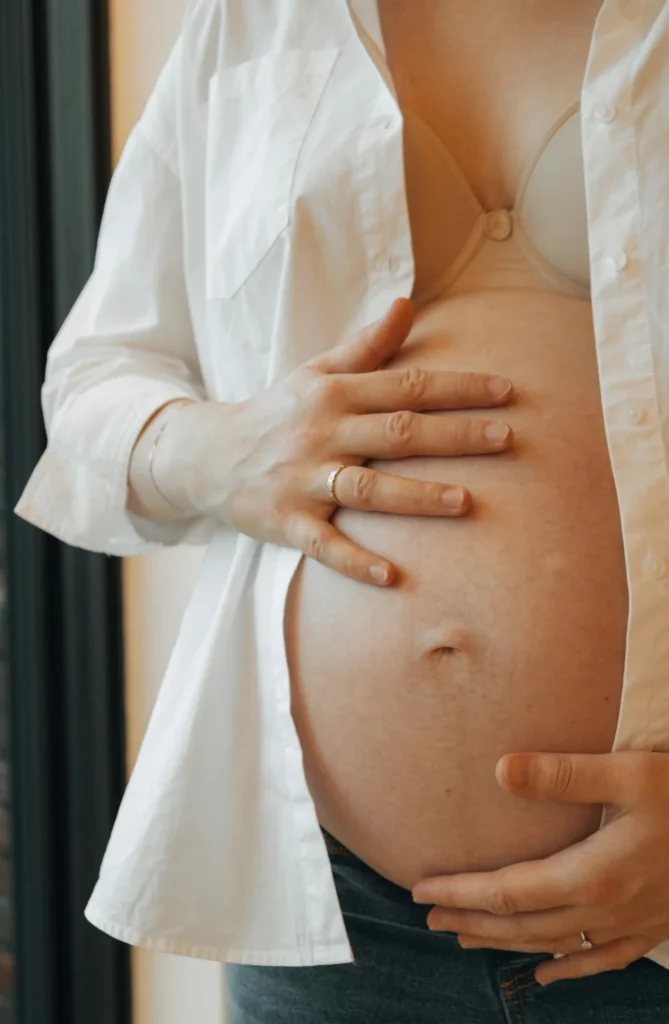
Week after week, the body changes quickly: the centre of gravity shifts, muscles and ligaments adapt, tension can set in. As for the ligaments, the Institut national de santé publique du Québec (INSPQ, Québec’s public health institute) says they tend to loosen under the effect of pregnancy hormones, especially in the pelvic area.
A gentle touch. The techniques used are gentle, respectful of the body’s rhythm, with no abrupt manipulation.
During and after pregnancy. I see you throughout your pregnancy, then during the postpartum period.
Your medical care stays the same. Your doctor or midwife follows your pregnancy. Osteopathy comes in addition.
Why see an osteopath during pregnancy?
Here are a few examples of what brings pregnant women to a session.
Lower back or pelvic discomfort
Often, people come to see me for sensations that are a bit mechanical, like discomfort in the lower back or around the pelvis. I start by asking you what you’re feeling.
Tension in the back and between the shoulder blades
It’s something that comes up often: tension in the back or around the neck. I try to help you understand what’s going on.
Digestive discomfort
Some pregnant women also come for digestive discomfort. Others tell me about tension in the belly.
Muscle fatigue
People also tell me about tired muscles. As with everyone, I try to give you tips so you know what to do at home.
Body tension linked to changes in posture
According to the INSPQ, the weight of the uterus moves the centre of gravity forward, which can lead to changes in posture. During the session, I observe your posture and your movements.
Preparing for childbirth (within the scope of osteopathy)
Some pregnant women come to see me for this. Your doctor or midwife continues to follow your pregnancy, and osteopathy comes in addition.
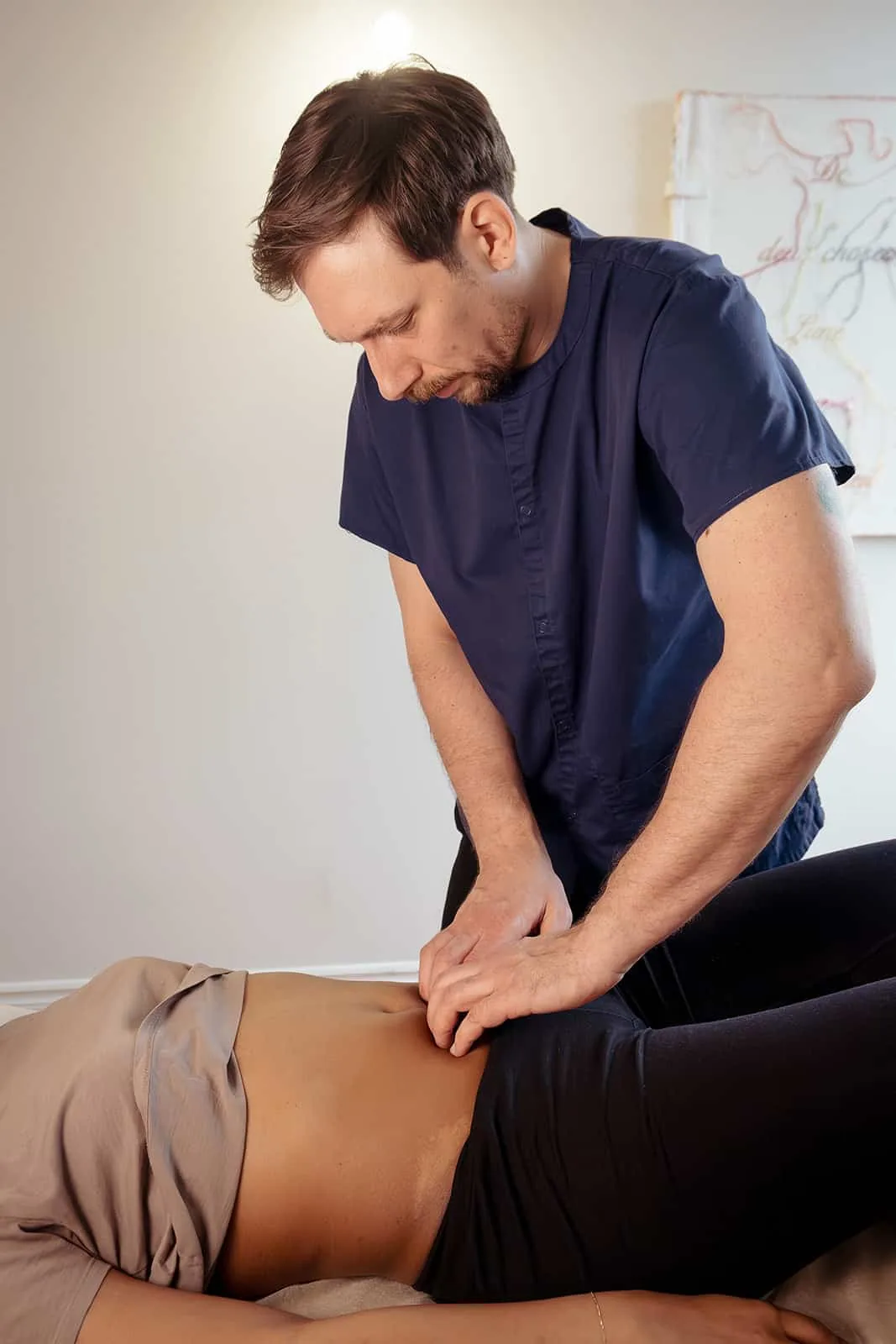
A gentle, hands-on approach, adapted to your pregnancy
An appointment is a conversation first, then a practical part. I describe what a first session looks like on the First osteopathy appointment page.
Your history and your daily life
We talk about what brings you in, your habits and your daily life. This is the case history (an in-depth questionnaire). We also go over your past: surgeries, injuries, long-standing discomfort.
Your posture and your movements
The practical part starts with observing your posture and your movements. Without ever making a medical diagnosis, I look for areas of tension or restricted mobility that could make daily life less comfortable.
Techniques adapted to your body
Every pregnancy is different, and needs change from one trimester to the next: I adapt my techniques to the changes in your body.
After the appointment
The effects of the session can be felt in the days that follow, depending on how your body responds. If a reaction raises questions, write to me: I’m available.
During pregnancy and after childbirth alike, the session lasts as long and costs the same as my other sessions.
And after childbirth?
The postpartum period is another major stage in a woman’s life. I see new moms too. During pregnancy and childbirth, several areas of the body were heavily called upon:
- The pelvis
- The diaphragm
- The abdominal muscles
- The pelvic floor
Osteopathy can support their recovery, particularly if you’re breastfeeding. According to the INSPQ, the physical changes brought on by your pregnancy and childbirth can last for several months.
For your baby, I offer sessions from birth: see osteopathy for babies and infants.
What osteopathy doesn’t replace
- Osteopathy supports you during your pregnancy, alongside the care of your doctor or midwife, never in its place.
- I don’t make diagnoses: if something worries you, turn to them first.
- If I see that physiotherapy could be useful to you, for example for perineal rehabilitation, I can point you toward physiotherapists who specialize in perinatal care and whom I work with.
If you’re worried about your health, contact your doctor or midwife, or call Info-Santé 811, which answers day and night.
Who you’ll see at the practice
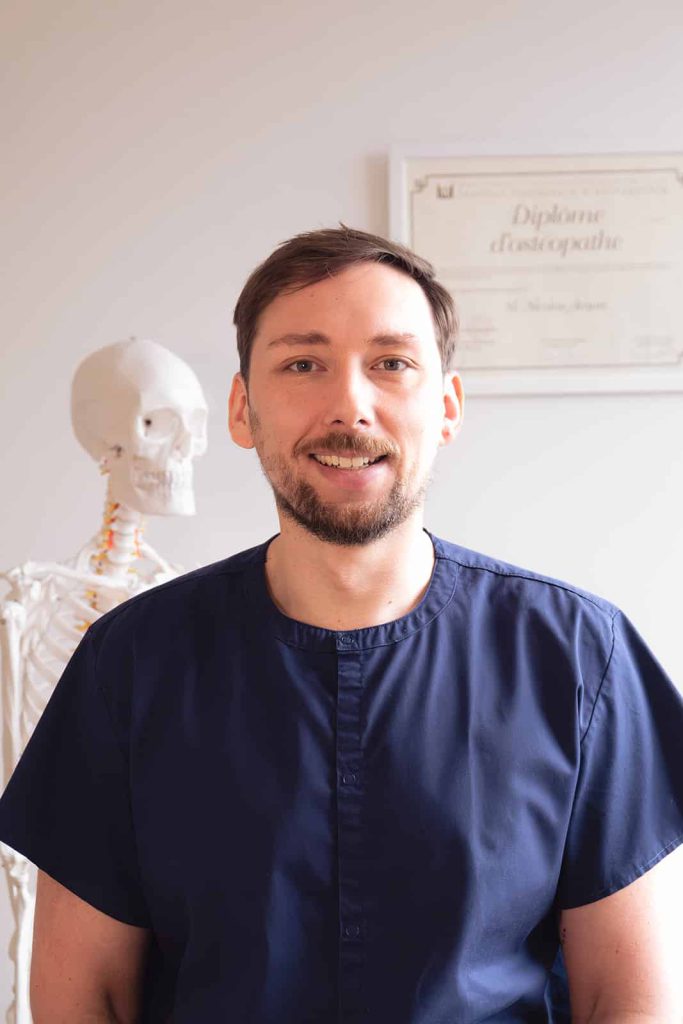
I’m Nicolas Acquié, an osteopath and teacher, and I welcome pregnant women to my practice at 910 rue Bélanger Est, Suite 206, steps from Jean-Talon métro. I’m an osteopath D.O. (graduate in osteopathy). I earned my diploma at the Institut Toulousain d’Ostéopathie (France) in 2013. I opened my practice in June 2020. I also teach at the IEOQ, the Institut d’Enseignement de l’Ostéopathie du Québec. I’m a member of Ostéopathie Québec, a professional association. I took the webinar “Le 4e trimestre de grossesse en ostéopathie” (the fourth trimester of pregnancy in osteopathy).
My backgroundFees and reimbursement
The session
1 hour, $125 plus taxes
Receipt
You receive a receipt by email, which you can submit to your insurer for reimbursement.
Insurance
Many private insurance plans cover part or all of the cost: check your “paramedical services” or “alternative therapies” coverage with your insurer.
Payment
Interac e-Transfer is the preferred way to pay.
Booking
No credit card or deposit required to book.
RAMQ
Osteopathy sessions are not covered by RAMQ, which runs Québec’s public health insurance plan.
The practice
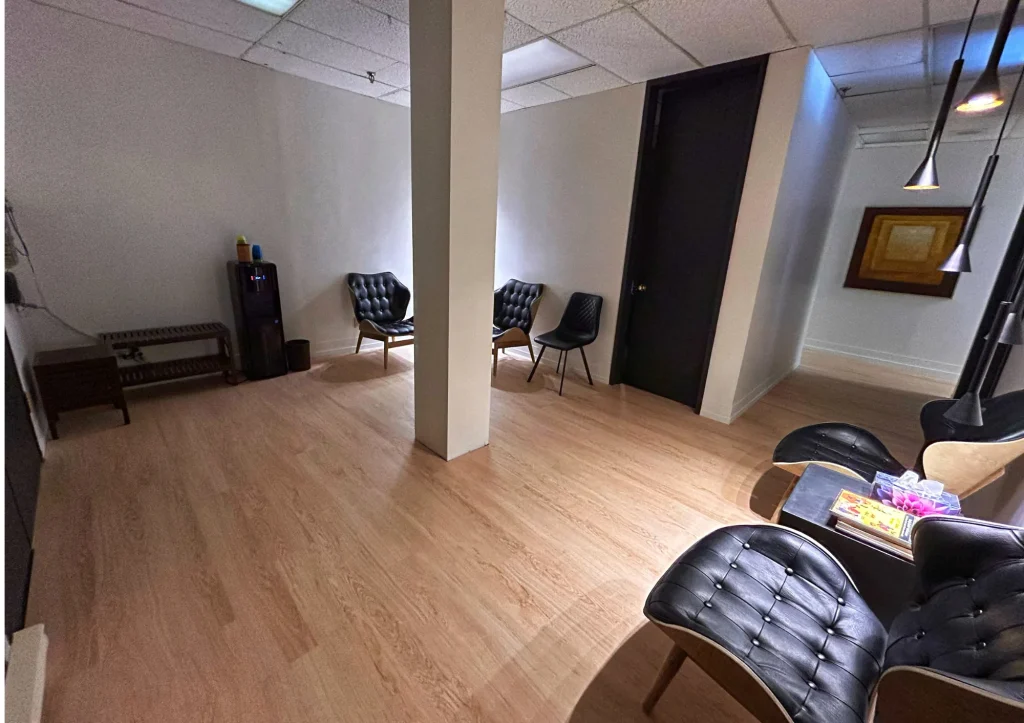
910 rue Bélanger Est, Suite 206, Montréal, Québec H2S 3P4, between Saint-André and Boyer streets
Centre professionnel Makisa
A ramp leads to the building entrance, and an elevator goes upstairs.
Jean-Talon station (orange and blue lines), the closest to the practice, 450 m away, about a 5-minute walk
By bus, the 95 Bélanger stops on either side of the practice, in both directions: Bélanger / Saint-Hubert and Bélanger / Christophe-Colomb stops.
Street parking nearby, and paid covered parking between Boyer and Saint-André streets (perfect when it snows).
 How to get to the practice
Book an appointment during pregnancy or after childbirth
When the time is right for you, book online on GOrendezvous, or by text at 514-663-3826.
Questions about osteopathy during pregnancy and after childbirth
Is it safe to see an osteopath during pregnancy?
It all depends on why you’re coming and on your situation. Often, the pregnant women I see come for tension or discomfort that’s rather mechanical, in the lower back, the legs, the belly or the neck. When it’s only that kind of discomfort and your pregnancy isn’t high-risk, I don’t ask you to see your doctor before coming. If it is high-risk, I ask you more questions. And if your condition isn’t optimal, I’ll generally point you elsewhere. My techniques stay gentle, with no abrupt manipulation.
From which month of pregnancy can you see an osteopath?
I see you in every trimester of your pregnancy.
How often should you come for sessions during pregnancy?
During a pregnancy, we see each other at least once or twice, and it can be more, but it’s case by case: it all depends on what brings you in. That’s what we figure out together at the first appointment. As much as possible, I try to give you tips, so you know what to do at home and understand what’s going on. If we realize there are several causes, we can plan more sessions fairly soon.
Can osteopathy prepare the body for childbirth?
Some pregnant women come to see me to prepare for childbirth, within the scope of osteopathy. An osteopath contributes to preparing the body for childbirth.
When should you come for a session after childbirth?
Generally, not right away. Childbirth is a tiring event: the idea is first to rest and get a bit of your energy back, then to see how things evolve. It depends on the person: I once saw a mom about two weeks after she gave birth. After a C-section, my techniques change a little, but the way I support you stays about the same.
Can I bring someone with me?
Yes. A loved one, a relative, a friend: the person of your choice can stay by your side during the session.